

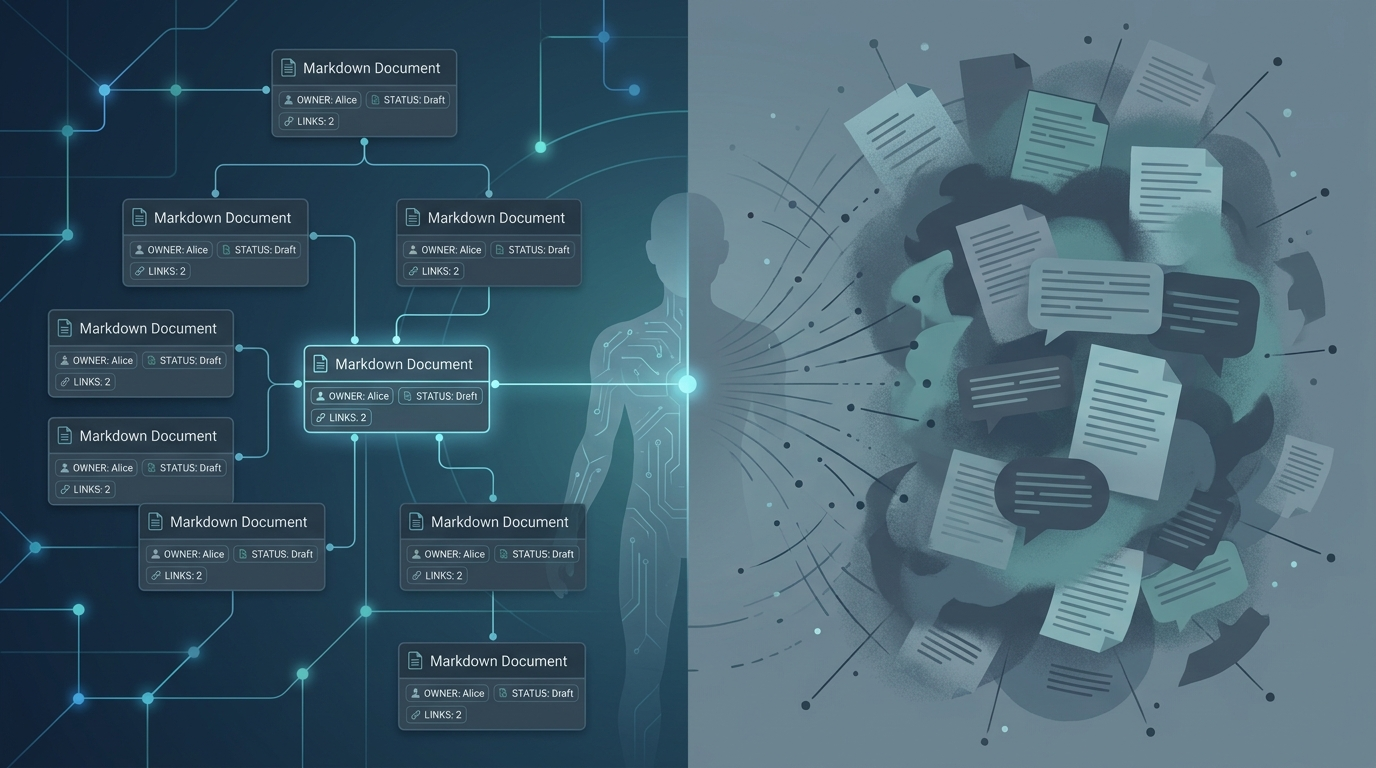
Over the past few years, Retrieval-Augmented Generation, or RAG, has become the default answer to one common question: how can a large language model access a company’s internal documentation?
The standard architecture looks reasonable. A team collects documents, splits them into smaller chunks, generates embeddings, stores them in a vector database, and retrieves the most semantically relevant fragments at runtime.
This approach works well when the goal is to search through a large body of documentation. However, the more I examined real-world AI-agent use cases in software development, testing, analytics, and enterprise systems, the clearer one limitation became:
Finding a similar fragment is not the same as finding the current and authoritative rule.
That is why I decided to examine Open Knowledge Format, or OKF, and determine whether it can become an alternative to traditional RAG-based knowledge systems.
My conclusion is that OKF does not replace vector databases completely. Instead, it addresses a different and highly important problem: it turns critical company knowledge into structured, controlled, and understandable context for both people and AI agents.
Why Traditional RAG Is Sometimes Not Enough
RAG is effective when an AI system needs to search through large collections of loosely structured information, including:
- internal documentation;
- support tickets;
- archived reports;
- chat history;
- technical notes;
- product specifications;
- old presentations and meeting summaries.
The problem begins when an answer must be exact rather than approximately relevant.
Consider the following questions:
- Which API field is currently required?
- How does the company calculate an active user?
- Which database schema is deployed in production?
- Which checks are mandatory before a release?
- Who owns a service, and when was its contract last updated?
A vector search engine measures semantic similarity. It may retrieve an outdated API specification, an informal chat discussion, an abandoned technical proposal, or an old presentation that still contains similar terminology.
Every retrieved fragment may be relevant to the topic, but the model must still decide which source is authoritative.
This creates several structural limitations.
1. Chunking Can Destroy Context
Large documents are usually divided into smaller chunks before indexing. As a result, a table, its validation rules, its exceptions, and its explanation may end up in separate fragments.
An AI agent may retrieve one part of the document without seeing the complete logic behind it.
2. Similarity Does Not Guarantee Accuracy
Even a high-quality embedding model does not automatically know whether a document is approved, outdated, experimental, or incorrect.
It measures similarity by meaning, not the operational status of the information.
3. Updates Require Additional Infrastructure
When a source document changes, the system may need to:
- process the document again;
- regenerate embeddings;
- update the vector index;
- invalidate outdated fragments;
- verify that the new version is available to the agent.
When an organization has many data sources, maintaining synchronization becomes a separate engineering problem.
4. Knowledge Ownership Is Often Missing
A traditional RAG pipeline may not provide clear answers to several important questions:
- Who owns this rule?
- When was it last reviewed?
- Which system is the original source?
- Is this information still active?
- Why was the rule changed?
For exploratory search, this may be acceptable. For API contracts, financial definitions, security policies, release criteria, or business rules, it becomes a serious risk.
What Is Open Knowledge Format?
Open Knowledge Format is an open specification for storing trusted knowledge and contextual information in a portable structure.
In OKF version 0.1, knowledge is organized as a directory of Markdown files with YAML frontmatter. Each file describes one concept, while its location in the directory acts as a stable identifier.
The format is intentionally simple.
A concept requires a type field, while teams may define additional metadata based on their own domain. Relationships between concepts are represented through regular Markdown links.
As a result, a directory of text files gradually becomes a knowledge graph that can be read by:
- developers;
- QA engineers;
- analysts;
- automation scripts;
- AI assistants;
- autonomous agents.
OKF is not a new database, an LLM framework, or a proprietary cloud platform. It is a convention for representing knowledge in a way that remains portable across tools and systems.
What a Knowledge Bundle Can Look Like
I adapted the OKF concept to a typical software product containing backend services, automated tests, business metrics, API contracts, and operational instructions.
product-knowledge/
├── index.md
├── services/
│   ├── index.md
│   ├── order-service.md
│   └── payment-service.md
├── api-contracts/
│   ├── index.md
│   └── create-order.md
├── quality/
│   ├── index.md
│   ├── regression-scope.md
│   └── release-criteria.md
├── metrics/
│   ├── index.md
│   └── escaped-defects.md
└── incidents/
    ├── index.md
    └── payment-timeout-2026-06.md
Each file has a specific responsibility.
For example:
create-order.mddescribes the active API contract;regression-scope.mddefines the mandatory checks before release;escaped-defects.mdexplains how a quality metric is calculated;- an incident file records a known failure and links it to affected services.
A concept file may look like this:
---
type: api_contract
title: Create Order API
owner: commerce-platform
status: active
timestamp: 2026-07-10T09:30:00Z
tags: [orders, api, checkout]
---

# Create Order API

Endpoint: `POST /api/v1/orders`

## Required Fields

- `customer_id`
- `currency`
- `items`

## Validation Rules

The request must contain at least one item.

Each item must include:

- `product_id`;
- `quantity`;
- `unit_price`.

## Related Knowledge

- [Order service](../services/order-service.md)
- [Regression scope](../quality/regression-scope.md)
- [Payment timeout incident](../incidents/payment-timeout-2026-06.md)
The purpose of this file is not to preserve every discussion ever held about the API.
Its purpose is to provide a short, current, and verified definition of one concept.
Where I See the Main Value of OKF
Knowledge Becomes Part of the Repository
Markdown files can be stored in Git together with the application code or in a dedicated knowledge repository.
Every change can go through a pull request and include:
- an author;
- a review;
- a timestamp;
- a change history;
- a reason for the update.
This is fundamentally different from receiving several semantically similar fragments with unknown status.
With Git, a team can see who approved a rule, why it changed, and which version was active at a specific point in time.
One Format Works for Both Humans and Agents
OKF does not require a special interface.
A developer can open the file in an editor. A QA engineer can review it in GitHub. An analyst can access it through an internal portal. An AI agent can parse the YAML metadata and follow the links.
This reduces the need to maintain two separate forms of documentation:
- a human-readable version;
- a machine-specific representation created only for an AI system.
Explicit Relationships Are Better Than Accidental Matches
If an API contract is related to a service, a regression suite, and a known incident, those relationships can be defined directly.
The AI agent does not need to guess which documents might be relevant. It can follow an explicit path through the knowledge structure.
Ownership and Status Become Part of the Context
YAML frontmatter may contain:
- the concept owner;
- its status;
- the last update time;
- tags;
- source references;
- confidence level;
- review date;
- deprecation information.
Because OKF does not force one fixed metadata model, each team can define the fields required by its own processes.
OKF Versus RAG Is the Wrong Comparison
At first glance, OKF may appear to be a direct replacement for RAG. In practice, the two approaches solve different problems.
| Use Case | RAG | OKF |
|---|---|---|
| Searching large document archives | Strong use case | Not the primary purpose |
| Finding approximately related content | Effective | Limited |
| Storing canonical business rules | Requires extra controls | Natural use case |
| Version control | Depends on the source and pipeline | Native through files and Git |
| Explicit relationships between concepts | May be lost during chunking | Preserved through structure and links |
| Working with unstructured archives | Effective | Requires prior organization |
| Auditing changes | Often difficult | Transparent in the repository |
RAG answers the question:
“Which information is most similar to this request?”
OKF answers a different question:
“Where is the approved knowledge, and how is it connected to other concepts?”
These systems are not direct competitors. They operate at different levels of information quality and certainty.
A Practical Scenario for QA and Development
Imagine that an Order schema has changed and an AI agent receives the following request:
Which automated checks must be executed before the release, and which known risks affect this service?
In a pure RAG architecture, the agent may retrieve:
- an outdated test plan;
- a message from a team chat;
- an incident report from two years ago;
- a README fragment from another service version;
- the current document hidden among several similar results.
With OKF, the agent can begin with services/order-service.md, move to quality/regression-scope.md, inspect the current API contract, and review the linked incident records.
RAG may still be useful afterward. It can search for:
- additional bug reports;
- historical discussions;
- support tickets;
- logs;
- related incidents;
- user complaints.
However, the foundation of the answer is already based on a controlled set of knowledge.
The most reliable sequence, in my view, is:
- The agent retrieves canonical rules from OKF.
- It expands the context through RAG.
- It separates verified facts from supporting historical material in the final answer.
A Hybrid Architecture Instead of a Radical Replacement
The most practical design is a context router that selects the correct source based on the type of request.
User Request
     │
     ▼
Context Router
     │
     ├── Canonical rules, schemas, runbooks ──► OKF Bundle
     │
     ├── Archives, chats, reports ─────────────► RAG Pipeline
     │
     └── Live operational data ────────────────► APIs / Databases
When a user asks for the approved definition of a business metric, the agent uses OKF.
When the user wants to find similar incidents from the past two years, the agent uses vector search.
When the user needs the current deployment status, the agent calls a monitoring API or operational database.
This architecture does not try to force one technology to solve every problem. Instead, it chooses a source according to the nature of the information.
What OKF Does Not Solve Automatically
Despite its simple structure, OKF does not eliminate every problem associated with enterprise documentation.
Knowledge Still Needs Maintenance
If a team does not update the files, they will become outdated just like any traditional wiki.
AI agents may help by creating pull requests when source code, schemas, or contracts change. However, responsibility for verification must still be clearly assigned.
Access Control Is Still Required
A knowledge bundle may contain:
- internal API contracts;
- financial definitions;
- operational procedures;
- infrastructure details;
- security-related instructions.
The format itself does not replace authorization, encryption, permissions, or data-governance policies.
Not Every Dataset Should Become a Concept
It would make little sense to manually structure millions of support messages, application logs, or historical conversations as individual OKF concepts.
For those sources, RAG, full-text search, and analytical databases remain more suitable.
Knowledge Modeling Requires Discipline
A team must agree on:
- concept types;
- naming conventions;
- required metadata;
- directory structure;
- linking rules;
- review policies;
- deprecation procedures.
Without these conventions, the knowledge bundle can quickly become another disorganized documentation folder.
How I Would Test OKF in a Real Project
I would not begin by migrating the entire company knowledge base.
A better approach is to select one limited area where an incorrect AI answer has a visible cost.
For example, a pilot project could cover one backend service and include:
- the service purpose;
- active API contracts;
- key entity schemas;
- the regression scope;
- release readiness criteria;
- known limitations and incidents;
- an owner for every concept.
After that, I would prepare a set of control questions and compare three modes:
- an LLM without additional context;
- an LLM using traditional RAG;
- an LLM using OKF together with RAG.
The evaluation should not focus only on whether the answer sounds convincing.
More useful metrics would include:
- the percentage of answers based on current rules;
- the number of outdated sources used;
- the accuracy of navigation between related concepts;
- the ability to identify the knowledge owner;
- the time required to update context after an API change;
- the reproducibility of answers to identical questions;
- the quality of source attribution.
This kind of experiment would demonstrate the practical value of OKF more clearly than a small set of idealized examples.
My Conclusion
Open Knowledge Format reflects an important change in the design of enterprise AI systems.
At an earlier stage, the main objective was to give language models access to as much text as possible.
The next challenge is more difficult: teaching AI systems to distinguish between:
- archived information;
- informal discussions;
- experimental proposals;
- current operational data;
- approved and canonical knowledge.
RAG remains a powerful tool for broad retrieval. Vector databases are not disappearing, and they are not becoming irrelevant.
However, semantic similarity alone is not enough for tasks that require precision, version control, accountability, and auditability.
OKF introduces a simple but promising principle:
Critical knowledge should have a stable location, a clear structure, explicit relationships, an owner, and a visible history of changes.
I would therefore describe OKF not as a replacement for RAG, but as a structured trust layer for enterprise knowledge.
Combined with vector search, APIs, databases, and other tools, it can help AI agents become not only more informed, but also more predictable, traceable, and reliable.