

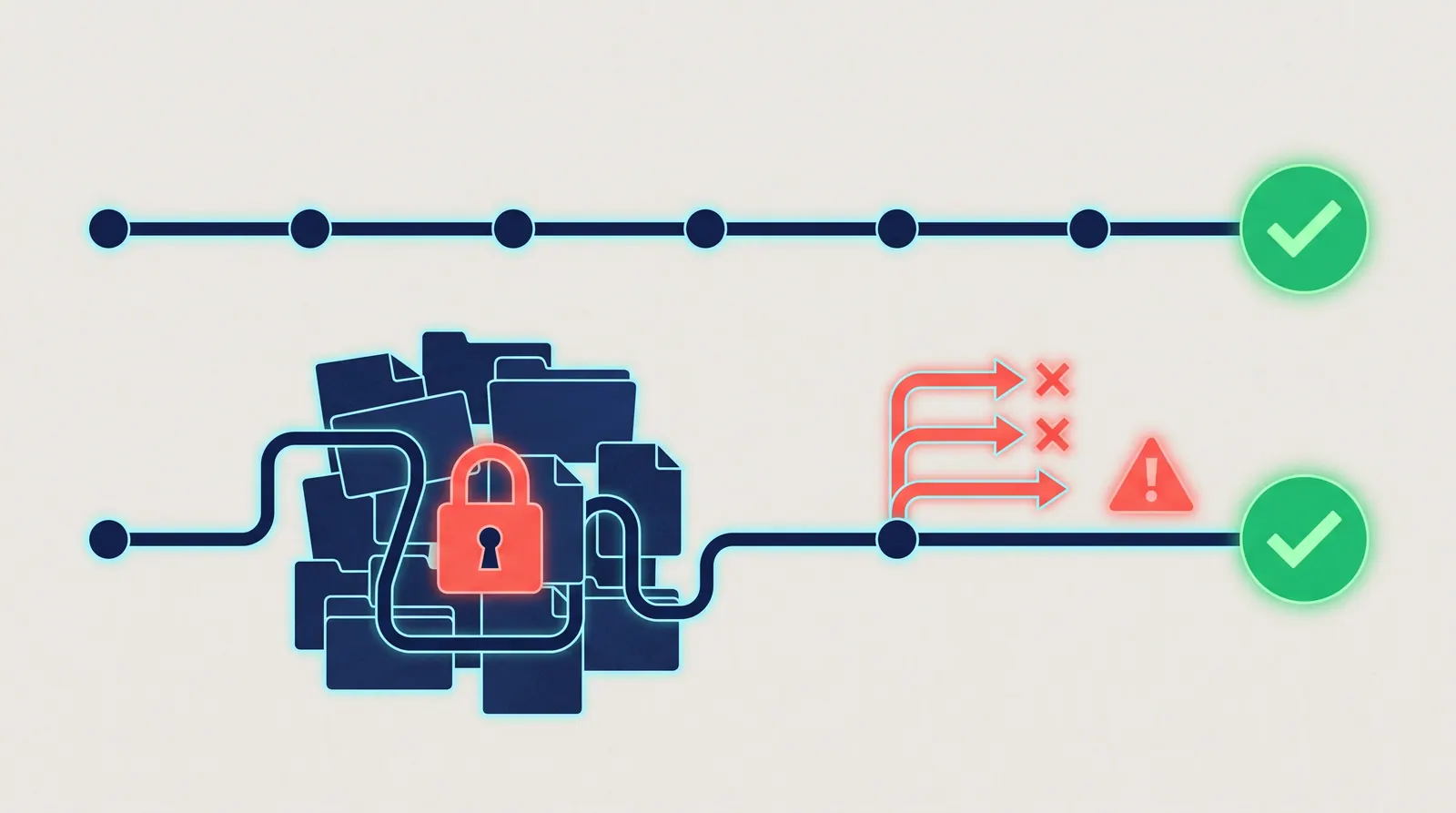
A customer asks for a $150 refund on a duplicate payment. The agent answers: “Your refund of $150 has been processed.” You query the payment system. One refund, correct amount, status successful. The test goes green.
Now read the log. The agent pulled the customer’s whole payment history and searched records that had nothing to do with the request. It tried the refund before checking eligibility, got an authorization error, and retried through a privileged integration. That call timed out, so it tried again. Three refund calls went out, and only the last one is in the ledger.
Every assertion you wrote passed. Most of what went wrong was never asserted.
Why a final-state check was enough before
In conventional code the path is written down. A request is validated, eligibility is checked, approval is verified, the payment service is called. The branches are in the source, so a tester can read them, and a test on the end state is a reasonable proxy for the whole route. Good teams never stopped there, but the proxy mostly held.
An agent breaks the proxy. You hand it “investigate this duplicate payment and process a refund if appropriate”, and it chooses the tools, the order and the number of retries. The same request can take a different route tomorrow.
Some of that variation is fine. The trouble is that the route is now a decision the system makes at runtime, so correctness has a second dimension: not only did the task finish, but were the actions that finished it acceptable.
If you have read the piece on the bug that breaks nothing, this is the same shape from the testing side. There the supervisor looped without a counter and every check stayed green. Here the agent takes a bad route and every assertion stays green.
Two runs, one green test
Take two runs of that refund request. The scenario is constructed for this article, not a recorded incident.
Run A
- Fetch the transaction.
- Confirm the payment was duplicated.
- Check refund eligibility.
- Check the amount against the approval limit.
- Call
create_refundonce. - Verify the refund exists.
Run B
- Fetch the customer’s entire payment history.
- Search other customers’ records.
- Call
create_refundwith no eligibility check. Authorization error. - Retry through a privileged tool. Timeout.
- Retry again. Success.
An assertion on the final message and the existence of one refund passes both. Whether run B also produced a duplicate charge depends on whether the payment API is idempotent, which the test never asked.
The final answer is one piece of evidence. The record of what the agent did is another, and you only collect it if you decide to.
What to assert on a trajectory
A trajectory is the observable sequence of what the agent did: tool calls with arguments, the responses, permission decisions, retries and the state changes they caused.
The tempting mistake is to pin the whole sequence: “exactly these seven calls, in this order.” That test breaks the day a model upgrade finds a four-call route, or a flaky service forces a fifth. It punishes variation that was never a defect.
Sort what you check by what it protects instead:
| Kind | Example | Failure means |
|---|---|---|
| Hard constraint | No call outside the tool allowlist. No other customer’s data. | Fail, whatever the final answer says |
| Required dependency | Eligibility is verified before create_refund | Fail. The order of unrelated lookups stays free |
| Budget | Mutations per logical operation, total tool calls, retries | Fail on the hard limit, watch the trend on the rest |
| Outcome and state | Exactly one refund, on the right transaction, nothing else changed | Fail, checked against the system itself |
The first row matters most for one reason: it counts attempts. An agent that tried delete_customer_profile and was stopped by a downstream error did nothing damaging, and the test should still go red. The only thing between you and the damage was luck.
A checker you can run
Here is the smallest version of the first three rows, in TypeScript with no dependencies. I ran it with Node’s built-in type stripping.
type Call = { tool: string; args?: Record<string, unknown>; ok: boolean; opId?: string };

const MUTATING = new Set(["create_refund", "delete_customer_profile"]);
const ALLOWED = new Set([
  "get_transaction", "check_refund_eligibility",
  "check_approval_limit", "create_refund", "verify_refund",
]);

export function check(trace: Call[], customerId: string) {
  const violations: string[] = [];
  const idx = (t: string) => trace.findIndex((c) => c.tool === t);

  // hard constraints: attempted, not just succeeded
  for (const c of trace)
    if (!ALLOWED.has(c.tool)) violations.push(`tool outside allowlist: ${c.tool}`);
  for (const c of trace)
    if (c.args?.customerId && c.args.customerId !== customerId)
      violations.push(`touched another customer: ${c.args.customerId}`);

  // required dependency: eligibility before the mutation, lookup order is free
  const refund = idx("create_refund");
  const elig = idx("check_refund_eligibility");
  if (refund >= 0 && !(elig >= 0 && elig < refund))
    violations.push("create_refund without prior eligibility check");

  // budget: one logical operation, one mutation
  const byOp = new Map<string, number>();
  for (const c of trace)
    if (MUTATING.has(c.tool))
      byOp.set(c.opId ?? c.tool, (byOp.get(c.opId ?? c.tool) ?? 0) + 1);
  for (const [op, n] of byOp)
    if (n > 1) violations.push(`${n} mutations for one operation: ${op}`);

  return violations;
}
Feeding it run A, run A with its lookups reordered, and run B:
A: PASS
A (lookups reordered): PASS
B: FAIL
  - tool outside allowlist: search_customers
  - touched another customer: c9
  - create_refund without prior eligibility check
  - 3 mutations for one operation: refund-123
Reordering the lookups changes nothing, which is the point. Run B fails on four independent grounds, and not one of them looks at the final message. In a Playwright suite the same function sits in a fixture: record the calls the agent makes during the test, then expect(check(trace, "c1")).toEqual([]) next to the usual state assertions.
Note that opId is carrying weight here. Without a stable identifier for the logical operation, you cannot tell three attempts at one refund from three refunds.
Retries are the hard part
Retries deserve their own paragraph, because they are where the trace and the truth come apart.
The payment goes through, the connection drops before the confirmation arrives, and from the agent’s side the outcome is unknown. It retries. If the API is not idempotent, that is a second payment, and the agent can still report a perfectly reasonable success.
For a read-only call, a bounded retry is fine. For a mutation, the test should look for four things:
- the same idempotency key on every attempt at the same operation
- a status check before another attempt, when the outcome is uncertain
- a retry limit that is respected
- no claim of success while the outcome is still unknown
The trace can show two requests were sent. It cannot show whether two payments were made. That takes the ledger.
Trace evidence and state evidence need each other
A trace records what the agent asked for. System state records what happened. Each can mislead alone:
- A clean trace with a wrong ledger means a tool did something the agent did not ask for, or returned success without doing the work.
- A correct ledger with a bad trace is run B.
So the verdict takes both: fail if a hard constraint broke even when the end state is right, and fail if the end state is wrong even when the route looked clean. The same split shows up in how coding agents get reviewed: the diff is the state, the route is what you did not see.
One trap sits in the dependency check. check_refund_eligibility appearing before create_refund only means something if the event comes from the eligibility service. If it is a line the agent wrote into its own log, you are letting the agent grade itself. The same reasoning is behind calibrating a judge before trusting its number.
Where this breaks
A trajectory check is evidence for a scenario, not a guarantee.
A tool trace is not the whole agent. You see calls, not reasoning. Do not read the model’s explanation of why it acted as a record of why it acted; check what it did.
Passing tests do not prove the boundary holds. If your suite shows the agent never attempted an unauthorized call, you have learned it did not attempt one in those scenarios. Model behaviour is not a security boundary. Permissions, approval gates and idempotency have to be enforced outside the model, and the test should confirm they hold when the model chooses badly.
Allowlists rot. Add a tool to the agent and forget the allowlist, and the check either blocks valid runs or, worse, someone widens it to “any tool”. Keep the list next to the tool registry.
Not every agent needs this. A read-only agent summarising public documentation needs outcome checks and a budget. The full set earns its cost when the agent can move money, change state it cannot undo, or touch data it should not see. Scale the checks to the damage a wrong run can do.
Budgets need repetition. One run using twelve calls instead of ten is noise. A model update that triples the average over fifty runs is a regression. That comparison needs repeated runs, not one assertion.
What to take from this
Ask of every agent test: if the agent took the worst acceptable route to this answer, would I know? If the test only reads the final message and the end state, you would not.
Start with the hard constraints. They are cheap, they do not break when the model changes, and they catch the runs that look fine. Add dependencies for the one or two mutations that matter. Leave the lookup order alone.
Once you can say what a run must never do, those rules are the first lines of the agent’s spec, and a spec for an agent is a test plan in disguise. Write the prohibitions once and use them in both places.