

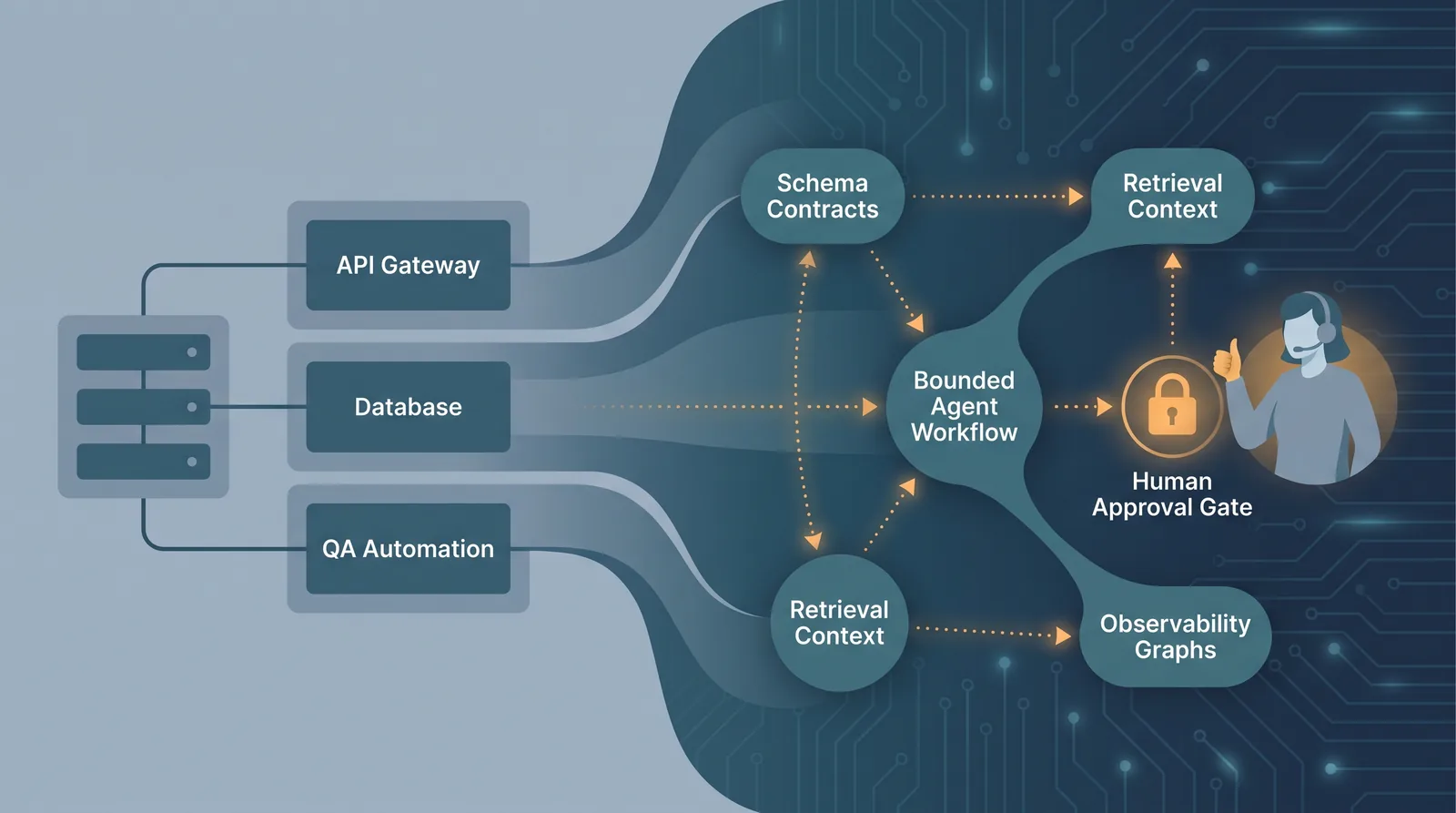
AI engineering is often presented as a new profession that requires immediate mastery of dozens of models, agent frameworks, vector databases, and prompting techniques. It is easy to spend months exploring tools without learning how to build a system that works reliably outside a controlled demonstration.
I decided to examine this field from the perspective of a QA Automation Engineer. My work has always been less about impressive demos and more about predictable behavior, controlled risk, reproducible results, and understanding what happens after a release.
For that reason, I was not interested only in how to connect a language model to an application. The more important questions were:
- How do we test an output that is not always deterministic?
- How do we prevent an AI agent from performing unsafe actions?
- How do we distinguish a real improvement from a lucky response?
- How do we control execution time and cost?
- How does a workflow recover after a failure?
- How can we explain why the system made a particular decision?
My main conclusion is that an AI engineer in 2026 is primarily a software engineer who knows how to integrate a probabilistic component into a controlled system.
A capable model is useful, but architecture, data, validation, observability, and guardrails determine whether a prototype can become a dependable product.
How AI Engineering Differs from Simply Using AI
A basic AI application can be created in one evening:
- receive a user message;
- send it to a model;
- display the generated response.
That is enough for a demonstration. It is not enough for production.
As soon as real users begin relying on the feature, familiar engineering problems appear:
- the model returns invalid JSON;
- an upstream service times out;
- a repeated request executes the same action twice;
- the response is well written but factually wrong;
- outdated documents enter the context;
- the agent selects the wrong tool;
- sensitive information appears in logs;
- a prompt update improves one scenario and silently breaks another;
- a workflow becomes too slow or too expensive.
I therefore see AI engineering as a combination of several disciplines:
- backend development;
- API and integration engineering;
- data engineering;
- automation;
- testing;
- observability;
- security;
- product thinking.
The language model is an important component, but it does not replace any of them.
Where I Would Not Start
During my research, I found several popular starting points that sound reasonable but often delay practical progress.
Training a Model from Scratch
Applied AI engineering rarely requires model training as the first step. Training is a separate specialization that demands deeper mathematics, large datasets, significant computing resources, and a different style of experimentation.
I would first learn how to use an existing model well, control its output, and integrate it into a conventional software workflow.
Advanced Fine-Tuning Without a Baseline
Fine-tuning makes sense only when the team already knows:
- which behavior is insufficient;
- why prompting, context, or workflow design did not solve it;
- which dataset will be used;
- how improvement will be measured.
Without a baseline, it is difficult to prove that anything became better.
Deep Tool Comparisons
A beginner can spend weeks comparing vector stores, frameworks, and models while the application still lacks timeouts, tests, and proper error handling.
I would choose one sufficiently simple tool and continue building. Architectural principles matter more than library names.
Endless Prompt Tuning
Changing a few words in a prompt and testing two convenient examples is not a reliable engineering experiment.
Every meaningful change should run against a stable scenario set. Otherwise, an improvement in one case can quietly create regressions elsewhere.
My Practical Roadmap: Five Layers
I would not organize the learning process around a list of technologies. I would organize it around five levels of system maturity.
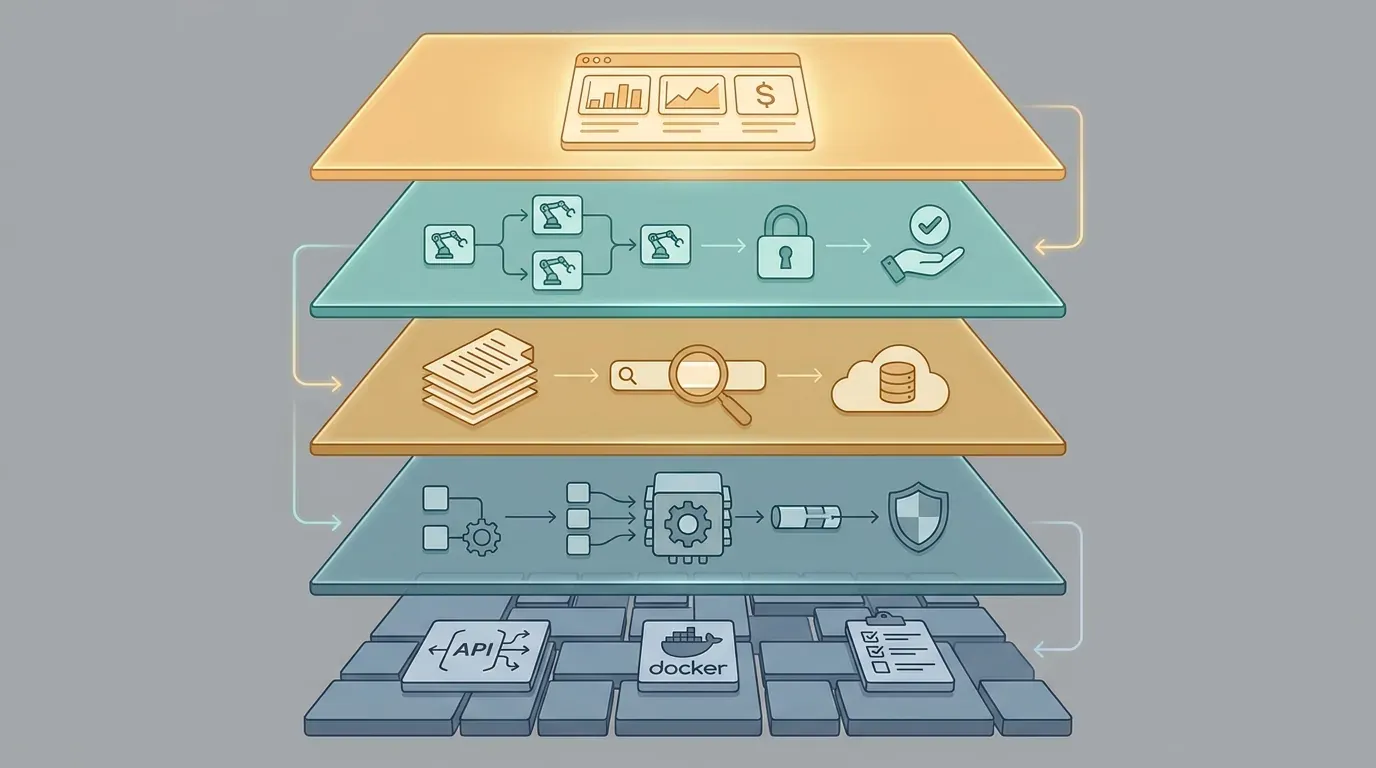
Layer 1: Conventional Engineering Fundamentals
Before adding AI, I would learn to build a reliable service without it.
My priorities would include:
- Python or another backend language;
- HTTP, REST, and the request lifecycle;
- JSON and schema validation;
- asynchronous programming;
- database fundamentals;
- logging;
- environment-based configuration;
- exception handling;
- Git;
- Docker;
- unit and integration testing;
- basic continuous integration.
This stage is complete not when a course has been watched, but when I can independently:
- build a small API;
- integrate an external service;
- handle failures and timeouts;
- test critical logic;
- run the application in a container;
- deploy it to a test environment.
Many early AI projects fail because of weak software foundations rather than weak models.
Layer 2: The Model as a Contract-Based Component
The next step is to stop using the model only as a text generator.
In an applied product, the result often needs a precise structure. An AI system may:
- classify a defect;
- assess release risk;
- extract fields from requirements;
- prepare API parameters;
- generate test scenarios;
- analyze logs;
- decide whether human review is required.
That requires a data contract.
from pydantic import BaseModel, Field
from typing import Literal

class ReleaseRisk(BaseModel):
    level: Literal["low", "medium", "high", "critical"]
    confidence: float = Field(ge=0, le=1)
    affected_areas: list[str]
    explanation: str
    requires_manual_review: bool
A schema alone does not make the system reliable. The surrounding code must account for:
- validation failure;
- empty output;
- model refusal;
- low confidence;
- retries;
- fallback behavior;
- maximum attempts;
- a safe final state.
For example, if confidence falls below a defined threshold, the system should not automatically block a release or update a ticket. It can prepare a recommendation and send the decision to a human.
This is where an AI feature begins to behave like a controlled software component rather than an experimental chat.
Layer 3: High-Quality Context and Retrieval
A model does not automatically know a company’s architecture, current API contracts, metric definitions, or recent code changes.
The next layer is learning how to build the right context.
I would study:
- document preparation;
- chunking;
- embeddings;
- vector and full-text search;
- metadata filtering;
- reranking;
- source version control;
- citations;
- evidence sufficiency;
- refusal when supporting data is missing.
The most important distinction is between retrieval quality and generation quality.
Outdated or poorly prepared source
                ↓
Bad document segmentation
                ↓
The required passage is not retrieved
                ↓
The model receives incorrect context
                ↓
A confident but inaccurate answer
Even the strongest model cannot use a fact that never enters its context.
I would therefore create two independent evaluation suites.
Retrieval Tests
They verify:
- whether the correct document was found;
- whether it appeared within the top results;
- whether metadata filters were applied correctly;
- whether outdated sources dominated retrieval;
- whether the collected context was sufficient.
Answer Tests
They verify:
- whether the conclusion is supported by the sources;
- whether unsupported claims were added;
- whether citations are correct;
- whether the system refuses to answer without evidence;
- whether the required format is preserved.
This is very close to conventional QA thinking: isolate system layers and test them independently.
Layer 4: Workflows and Controlled Agency
Only then would I move to systems where a model can select and invoke tools.
An incident-analysis agent, for example, might:
- read an alert;
- request monitoring metrics;
- inspect recent deployments;
- search for similar incidents;
- form a hypothesis;
- recommend the next step.
The main question is not whether the output sounds intelligent. The important question is which boundaries constrain the system.
I would implement:
- an allowlist of tools;
- permission checks;
- step limits;
- stop conditions;
- timeouts;
- persisted state;
- retries;
- idempotency;
- audit logs;
- human approval for high-risk actions;
- fallback behavior after failure.
A basic execution path might look like this:
Request
  ↓
Access validation
  ↓
Plan creation
  ↓
Approved tool selection
  ↓
Result validation
  ↓
Human confirmation for risky actions
  ↓
Execution and audit logging
I would not call every fixed three-step pipeline an agent. Agency begins when the system selects its next action within a defined set of permissions.
As freedom increases, guardrails must become stronger.
Layer 5: Production, Observability, and Evaluation
The final layer separates a portfolio demo from a product that a team can trust.
At this stage, I would work with:
- deployment;
- queues and background workers;
- caching;
- rate limits;
- observability;
- tracing;
- token usage;
- latency;
- cost per workflow;
- external-service degradation;
- security;
- privacy;
- incident response;
- regression evaluation.
An AI system is difficult to verify with one exact assertion. A combination of methods is required:
- deterministic checks;
- schema validation;
- a golden dataset;
- rubric-based assessment;
- version comparison;
- human review;
- production feedback;
- critical-error metrics.
Before release, I would want answers to five questions:
- What is the system’s baseline quality?
- Which dataset was used to measure it?
- Which failure types are critical?
- How will we detect regression after changing the model, prompt, or data?
- What safe experience will users receive when the system is uncertain?
Without these answers, the feature remains an experiment.
Four Projects I Would Build
For a portfolio, I would choose four complete systems instead of twenty similar chatbots.
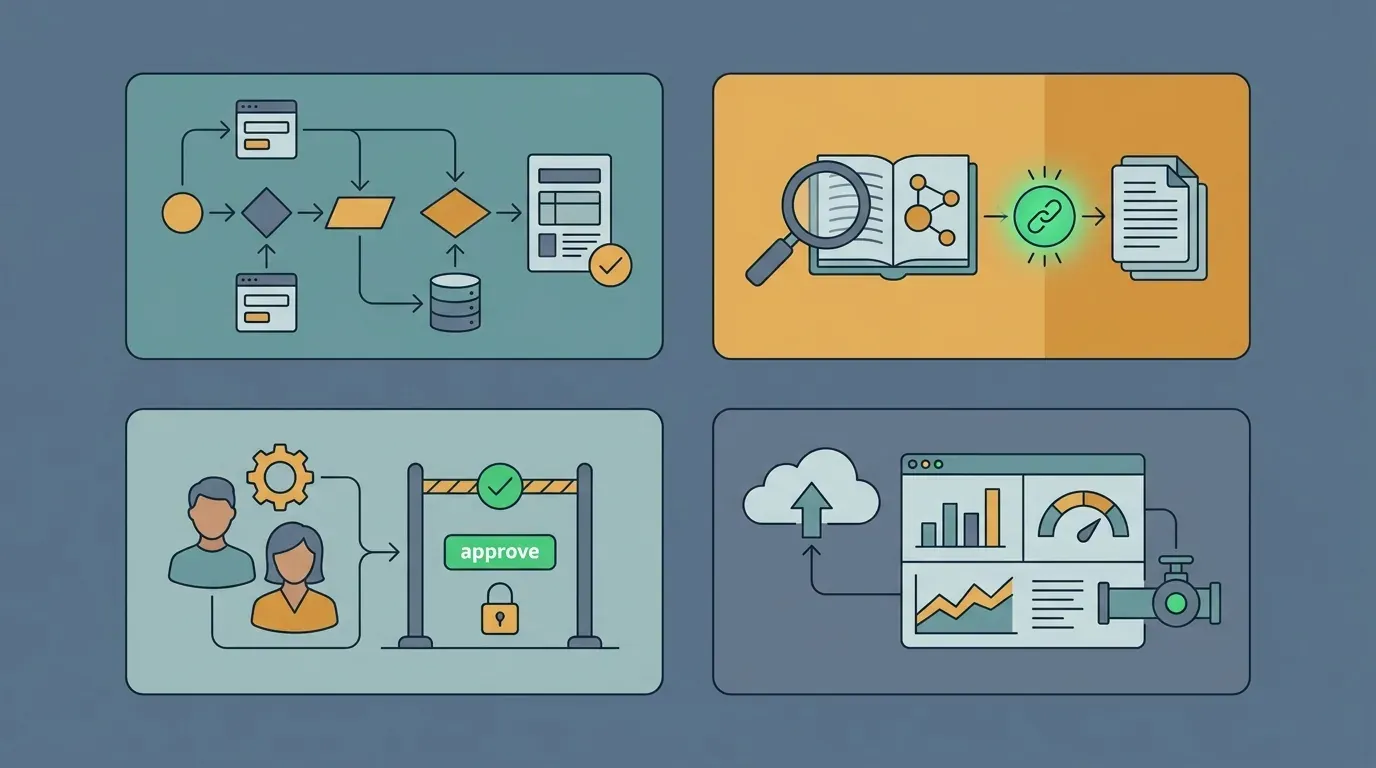
1. A Structured Analysis Service
Possible examples:
- a bug-report classifier;
- a log analyzer;
- a requirement extractor;
- a release-risk assessor;
- a test-scenario generator.
Required elements:
- input and output schemas;
- validation;
- retries;
- a confidence threshold;
- edge cases;
- automated tests;
- an evaluation dataset;
- a result report.
This project demonstrates that the model can participate in a conventional software pipeline.
2. An Assistant with Verifiable Context
This could be a knowledge system for APIs, test documentation, or operational runbooks.
The project should:
- index sources;
- preserve metadata;
- return evidence;
- expose the origin of an answer;
- refuse unsupported claims;
- include separate retrieval and answer evaluations.
The value is not the visual chat interface. It is evidence that retrieval works.
3. A Human-in-the-Loop Workflow
Possible use cases:
- incident triage;
- pull-request analysis;
- regression planning;
- release-risk assessment;
- internal request classification.
The system may gather information and recommend a decision, but a critical action is executed only after approval.
I would demonstrate:
- a state machine;
- transition logs;
- failure recovery;
- loop limits;
- an approval gate;
- access roles;
- tests for external-tool failures.
4. A Deployed AI Feature with an Evaluation Pipeline
The final project should work outside a local notebook.
I would include:
- an API or small interface;
- Docker;
- continuous integration;
- automated tests;
- an evaluation dataset;
- version comparison;
- telemetry;
- latency and cost metrics;
- safe degradation;
- a README explaining architectural decisions.
One project like this can reveal more engineering ability than many certificates.
My 12-Week Plan
Weeks 1–3: Software Foundation
The outcome is a small backend service without AI.
Focus:
- Python;
- APIs;
- asynchronous code;
- validation;
- logging;
- unit and integration tests;
- Docker;
- deployment.
Weeks 4–6: Controlled Model Integration
The outcome is a service that converts text into a validated structure.
Focus:
- structured output;
- schemas;
- retries;
- token limits;
- fallback behavior;
- a test dataset;
- error handling.
Weeks 7–9: Knowledge and Workflows
The outcome is a knowledge assistant or a tool-using workflow.
Focus:
- retrieval;
- chunking;
- filters;
- retrieval evaluation;
- tool calling;
- state management;
- human approval.
Weeks 10–12: Production and Quality
The outcome is a publicly accessible project that another person can run.
Focus:
- deployment;
- observability;
- evaluation;
- regression comparison;
- latency;
- cost;
- security;
- documentation.
How I Would Measure Progress
The number of courses, videos, or installed libraries says very little about engineering readiness.
I would use practical signals instead:
| Question | Evidence of Real Progress |
|---|---|
| Can I build a service without a step-by-step tutorial? | A working API, tests, and deployment exist |
| Can I explain a failure? | Logs, traces, and a clear root cause exist |
| Do I measure quality? | A dataset, baseline, and metrics exist |
| Do I control cost? | Cost per scenario is known |
| Can I detect regressions? | Automated version comparison exists |
| Are agent actions safe? | Permissions, limits, and approval gates exist |
| Can another person run the system? | The environment is documented and reproducible |
Progress is not knowing the definition of RAG or an agent.
Progress is the ability to build a system, measure it, identify a weak point, fix it, and prove that the result improved.
What I Would Show in a Portfolio
For every serious project, I would document:
- the problem;
- the architecture;
- the model’s responsibility boundaries;
- data and context;
- failure scenarios;
- the test strategy;
- the evaluation dataset;
- experiment results;
- latency;
- estimated cost;
- risks;
- known limitations.
Failed approaches are especially useful to describe.
For example:
The first workflow version could repeatedly call the same tool without making progress. I added a transition limit, a state-change check, and a fallback path. Infinite loops then disappeared from the evaluation set.
This shows real engineering experience rather than familiarity with terminology.
Common Traps
Learning Without Completing Systems
Watching tutorials creates a feeling of progress, but professional skill develops through independent debugging.
Choosing a Framework Before Learning the Fundamentals
An abstraction is difficult to troubleshoot when you do not understand what it hides.
Building Only Chatbots
AI engineering also includes extraction pipelines, background jobs, quality tools, workflows, and APIs. Chat is only one possible interface.
Working Without an Evaluation Dataset
Without a stable scenario set, there is no honest way to say that a new version is better.
Treating a Successful Demo as Proof of Reliability
One correct execution says nothing about edge cases, repeated requests, and external failures.
Giving an Agent Excessive Permissions
A model should not receive unrestricted access simply because it can explain its plan convincingly.
Ignoring Uncertainty
A good product does not hide when the system lacks enough evidence. It provides a safe next step.
Conclusion
If I were moving into AI engineering in 2026, I would not begin by chasing the newest model or the most popular framework.
I would build six capabilities in sequence:
- reliable software;
- explicit contracts;
- high-quality context;
- bounded workflows;
- production visibility;
- systematic evaluation.
Models will change. Some of today’s libraries will disappear. API providers will revise pricing and limits.
The ability to design systems, control failures, test risks, and measure results will remain valuable.
My central conclusion is this:
Becoming an AI engineer is not about learning how to obtain an answer from a model. It is about learning how to build a system that remains controlled, useful, and understandable when the model is wrong.
That is where an AI demo ends and real engineering begins.